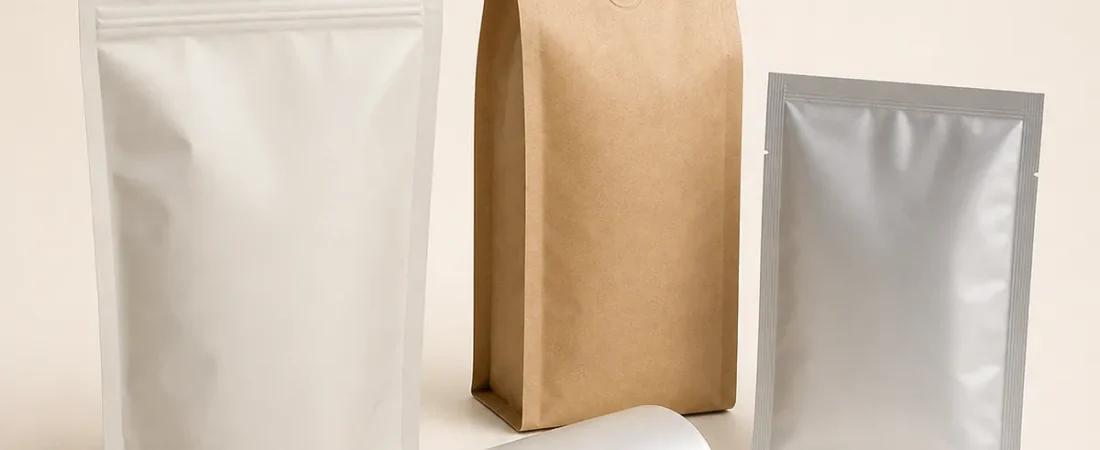
Flexible packaging is rarely defined by one material alone. A pouch or rollstock web may combine PET, PE, BOPP, aluminum foil, paper or coated films so that printing, stiffness, barrier, sealing and product-contact requirements are handled by the complete structure.
This guide explains the common role of each material in buyer-level terms. It does not assign a universal laminate to a product. Final selection should follow the product brief, filling process, package format, distribution conditions and appropriate testing.
Quick Answer
PET is often selected for printability, dimensional stability and toughness; PE is commonly used where heat sealing, flexibility and product-contact performance are required; BOPP can provide clarity, stiffness, print performance and useful moisture resistance; aluminum foil can provide strong light, oxygen and moisture barrier when the foil layer and finished package remain intact; and paper can contribute appearance, print surface and stiffness but usually needs another layer or coating when sealing or higher barrier is required.
These are typical functions, not fixed specifications. Grade, thickness, orientation, coating, metallization, adhesive, sealant, package geometry and converting conditions can change performance substantially.
Why Flexible Packaging Uses Multiple Materials
A single film may not provide every function a package needs. The outer surface must accept print and resist scuffing. The package may need stiffness for shelf presentation, toughness for distribution, a controlled oxygen or water-vapor transmission rate, and an inner surface that seals reliably on the filling line.
Multilayer construction allows those jobs to be divided. A typical structure may use an outer web for printing and mechanical support, a middle layer for barrier or stiffness, and an inner sealant layer. The correct combination depends on the complete package, not on which material name appears first in a specification.
PET: Print Surface, Strength and Dimensional Stability
PET in flexible packaging generally refers to polyester film, often biaxially oriented PET. It is widely used as an outer laminate because it can provide a smooth printing surface, dimensional stability, mechanical strength and resistance to handling. Those characteristics can support reverse printing, lamination and consistent package presentation.
Plain PET is not a universal high-barrier answer. Oxygen and moisture performance vary with grade, thickness and treatment. Coated or metallized PET can perform very differently from an uncoated transparent film. When PET is proposed, buyers should ask whether its role is print, stiffness, abrasion protection, barrier, or a combination of those functions.
PE: Sealant, Flexibility and Package Integrity
PE is a family of polyethylene materials rather than one uniform film. In many flexible structures, a PE-based inner layer is selected for heat sealing, flexibility, toughness and the intended product-contact application. Resin type, density, additives, film design and gauge influence seal initiation, hot tack, puncture resistance and line performance.
The sealant layer is part of the barrier system because poor seals can compromise an otherwise capable laminate. Filling temperature, product contamination in the seal area, zipper integration, jaw temperature, pressure and dwell time all affect package integrity. A structure should therefore be evaluated on the intended equipment rather than from a PE label alone.
BOPP: Clarity, Stiffness and Moisture Resistance
BOPP is biaxially oriented polypropylene film. Depending on grade and treatment, it can contribute clarity, stiffness, gloss or matte appearance, printability and useful resistance to water-vapor transmission. It is commonly found in labels, wraps, snack packaging and laminated pouch or rollstock structures.
BOPP grades are not interchangeable. Heat-sealable, coated, cavitated, matte and metallized films can have different optical, sealing and barrier behavior. BOPP should not be treated as a complete answer to oxygen, aroma or light protection unless the proposed grade and full construction are reviewed against measurable project requirements.
Aluminum Foil: High Barrier With Converting Considerations
An intact aluminum foil layer can provide very strong barrier to light, oxygen and moisture. That makes foil relevant to projects with demanding protection requirements, but foil is not automatically the best choice for every flexible package. Gauge, lamination, pinholes, repeated flexing, sharp creases and package handling can affect the finished result.
Foil also changes opacity, appearance, stiffness, metal detection considerations and the way a web converts. The decision should account for pouch geometry, sealing, zipper or valve integration, distribution stress and end-of-life requirements. Foil performance belongs to the complete package rather than to the foil layer in isolation.
Paper: Appearance and Structure, Not an Automatic Barrier
Paper can provide a natural tactile surface, print character, opacity and additional stiffness. In flexible packaging it may be used as an outer layer, a paper-look component or part of a coated or laminated construction. These options can support a distinct retail presentation while retaining the converting characteristics required for a pouch or wrap.
Paper alone should not be assumed to provide the required moisture, oxygen, grease or heat-seal performance. Coatings, laminates or separate sealant and barrier layers may be necessary. A paper-looking package is also not automatically recyclable; the complete structure and the applicable collection and recycling system must be evaluated.
How the Layers Work Together
Material selection becomes clearer when each layer has a stated job. The following construction is illustrative, not a recommendation for a specific product:
- Outer layer: print surface, scuff resistance, stiffness and mechanical protection.
- Functional layer: oxygen, moisture, aroma or light protection where required.
- Inner layer: heat sealing, product-contact suitability and resistance to the contents.
Adhesives, inks, coatings and primers also matter. They must be compatible with the web, filling process and intended application. The laminate then has to convert into a package without losing seal integrity or useful barrier performance.
Material Roles at a Glance
| Material | Common role in flexible packaging | Buyer questions |
|---|---|---|
| PET | Print surface, stiffness, dimensional stability and mechanical support; coated or metallized grades may add barrier. | Is the film plain, coated or metallized? What function and gauge are specified? |
| PE | Sealant, flexibility, toughness and product-contact layer in many structures. | What sealing window, filling conditions and puncture requirements apply? |
| BOPP | Clarity, stiffness, appearance, print surface and useful moisture resistance depending on grade. | Is it heat-sealable, coated, cavitated or metallized? What barrier is required? |
| Aluminum foil | Strong light, oxygen and moisture barrier when the foil and finished package remain intact. | What gauge, flexing risk, closures and converting conditions apply? |
| Paper | Print character, tactile appearance, opacity and stiffness within a coated or laminated structure. | Which sealing, grease, moisture and end-of-life requirements must the full structure meet? |
The table describes common roles only. It does not establish a performance ranking or substitute for an approved material specification.
Metallization, Coatings and Surface Treatments
Metallized PET or BOPP uses a thin deposited metal layer on a polymer film. It can provide opacity, metallic appearance and improved barrier compared with the underlying plain film, but it is not the same construction as a separate aluminum foil layer. Barrier depends on the base film, metal deposition, coating, handling and lamination quality.
Transparent barrier coatings, primers, seal coatings, matte finishes and other treatments can also change performance. Their presence should be documented because the base material name does not reveal them. Buyers comparing two “PET/PE” or “BOPP/PE” quotations should request the functional layer description, total gauge, layer gauges and relevant test data rather than assuming the structures are equivalent.
How Package Format Changes Material Selection
The same laminate can behave differently when converted into a stand-up pouch, flat-bottom pouch, side-gusset bag, sachet or rollstock package. More complex geometry can introduce additional folds, seals and stress points. Package size, fill weight, drop risk and headspace also affect the mechanical brief.
Closures are part of the decision. A zipper changes sealant and converting requirements, while a coffee degassing valve adds another component and interface that must be evaluated. For format-level considerations, see the Pouch Format Selection Guide. For protection requirements, see How to Choose a Packaging Barrier Structure.
Printing, Lamination, Sealing and Testing
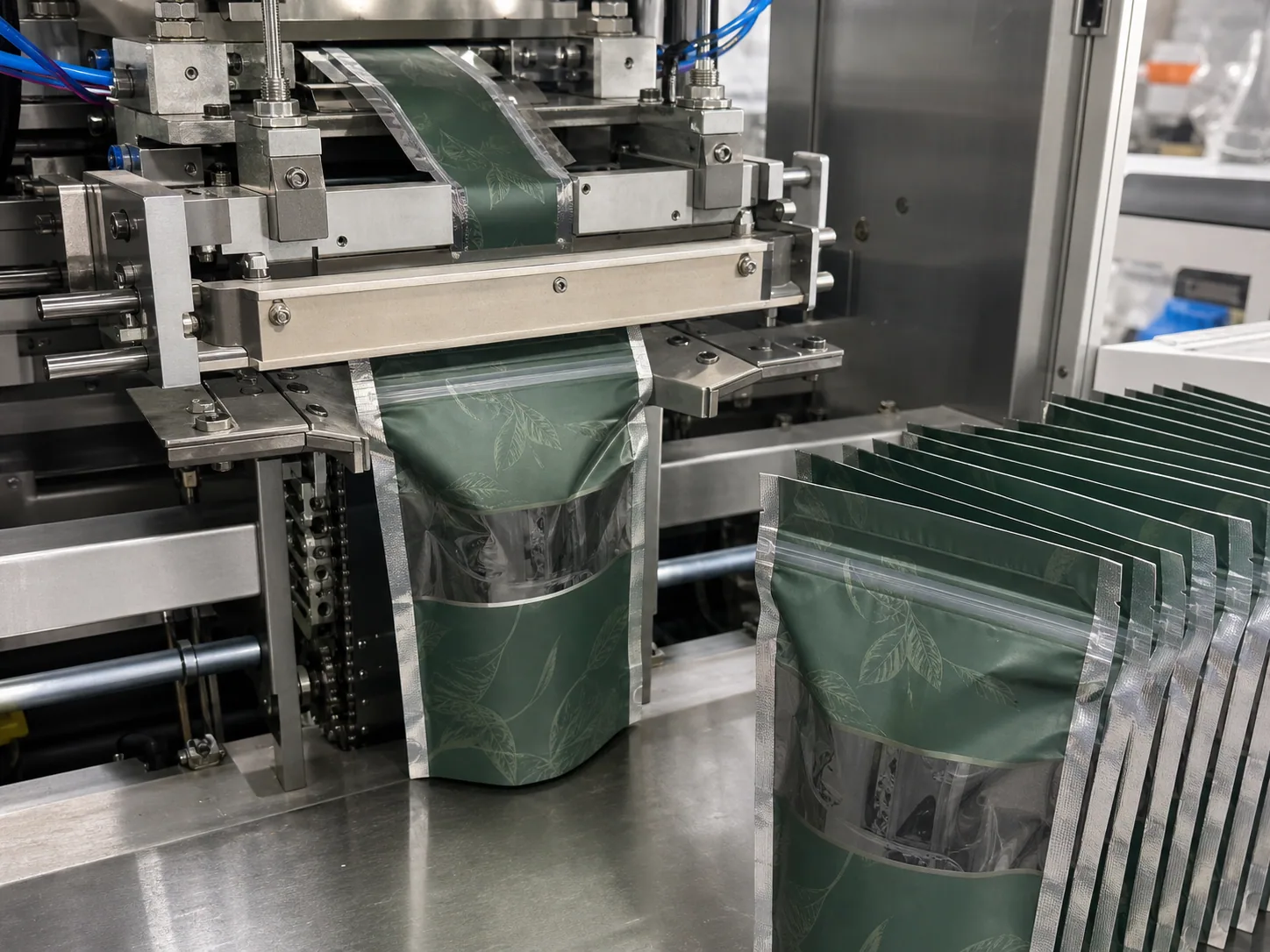
Materials must run through the complete production sequence. Surface energy and treatment affect printing and lamination. Adhesive selection and cure conditions affect bond development. Web tension, temperature and registration affect converting. Sealant behavior must match the filling line and the final closure system.
Samples should be reviewed for appearance, dimensions, opening and closure behavior, seal quality and compatibility with the product and equipment. Project-specific testing may include transmission, bond, seal-strength, leak, drop or distribution evaluation as appropriate. Royal Pack Group’s Packaging Manufacturing and Quality Control pages explain the broader production and inspection workflow.
Common Material-Selection Mistakes
- Choosing a material because its name or appearance sounds premium.
- Assuming every PET, PE or BOPP grade has the same performance.
- Specifying a laminate before defining oxygen, moisture, light and handling requirements.
- Comparing total thickness without comparing layer functions and gauges.
- Ignoring seals, zippers, valves, folds and converted package geometry.
- Treating paper appearance as proof of barrier or recyclability.
- Assuming aluminum foil is necessary—or unnecessary—without reviewing the product brief.
- Copying another package structure without validating filling and distribution conditions.
FAQ
What is the difference between PET and PE in flexible packaging?
PET is often used as an outer print and support film because of its dimensional stability, strength and surface characteristics. PE is commonly used as an inner sealant and product-contact layer. Exact roles depend on grade, treatment, thickness and the complete laminate.
Is BOPP the same as PET?
No. BOPP is oriented polypropylene, while PET is polyester. Both can serve as printable outer films, but their stiffness, optics, moisture and oxygen transmission, heat response, coatings and converting behavior differ by grade.
Does aluminum foil provide better barrier than metallized film?
An intact foil layer can provide very strong light, oxygen and moisture barrier, while metallized films use a much thinner deposited metal layer. The right comparison depends on the grades, required performance, flexing risk, package format, converting process and finished-package testing.
Can paper be used in a heat-sealed pouch?
Paper can be part of a heat-sealed pouch when the complete construction includes compatible coatings, laminates or a separate sealant layer. Paper alone should not be assumed to provide the required seal, moisture, grease or oxygen performance.
Does a thicker laminate always perform better?
No. Thickness influences some mechanical and transmission properties, but layer function, material grade, coating, metallization, bond quality, seals and package geometry can be more important than total gauge alone.
Can one material structure work for every product in the same category?
Not reliably. Products in the same category can differ in formulation, moisture or oxygen sensitivity, fill process, shelf-life target, closure, package size and distribution conditions. Each project needs its own protection and converting brief.
What information should I provide for material selection?
Provide the product, package format, dimensions, fill weight or volume, protection requirements, shelf-life target, filling and sealing process, closure needs, storage and distribution conditions, target market, expected quantity and any applicable product-contact requirements.
Related Packaging
- Flexible Packaging
- Packaging Barrier Structure Guide
- Pouch Format Selection Guide
- Coffee Packaging
- Pet Food Packaging
- Supplements Packaging
- Manufacturing
- Quality Control
Request a Quote
A useful material recommendation begins with the product, package format, dimensions, fill weight or volume, protection requirements, expected quantity, filling process, closure needs and target market. Share those details through the Request a Quote pathway. Candidate materials should be confirmed through project review, sampling and appropriate testing before production approval.