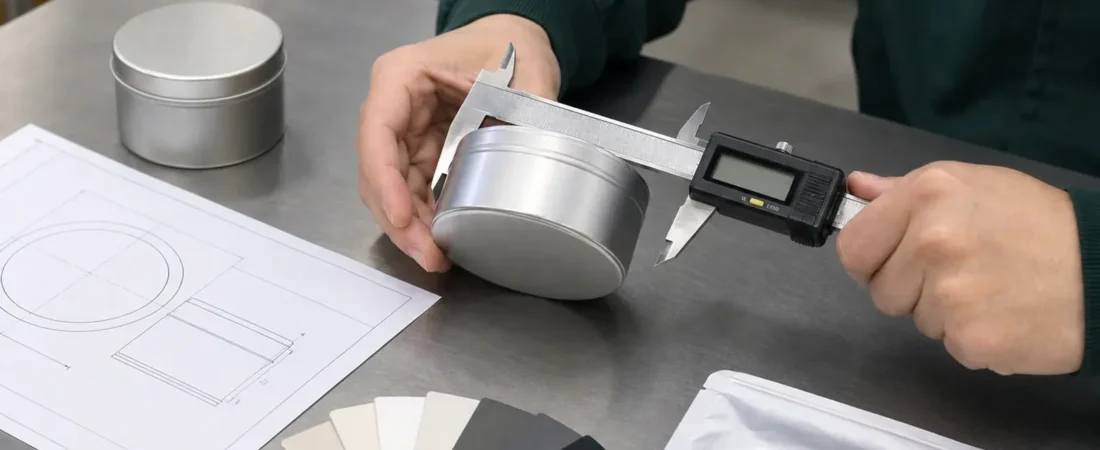
Packaging quality control is most useful when buyers define what must be supplied, how it will be evaluated and which approved references will control production. Without those foundations, an inspection can identify obvious defects but may not resolve whether a package meets the commercial and technical requirements of the project.
This guide explains the quality checks a B2B packaging buyer may review before approving production and shipment. The appropriate plan depends on the package format, product application, material structure, artwork, closure, distribution conditions and agreed specification. It is not a universal laboratory-testing program, and it does not imply that every project requires every test described below.
Quick Answer: What Should Packaging Buyers Review?
Packaging quality control should normally begin with an approved specification, current artwork and an agreed physical or documented reference. Depending on the project, the review may cover dimensions, material construction, printing, color, seals, closures, workmanship, function, quantity, labeling and the condition of goods prepared for shipment.
Additional testing may be appropriate when the package or product requires it. For example, a flexible package may need an agreed seal-strength, leak-integrity, oxygen-transmission or water-vapor-transmission evaluation, while a shipping pack may require a transport-related test plan. The applicable method, sample preparation, test conditions and acceptance criteria should be defined for the project rather than assumed.
- Approve the specification and artwork revision before production.
- Define measurable requirements where measurements matter.
- Use a controlled sample or reference to support visual approval.
- Match inspection and testing to the package format and application.
- Confirm sampling and acceptance rules before goods are produced.
Why Packaging Quality Control Starts With the Specification
An inspection result can only be compared with something. The specification establishes that comparison by defining the package type, dimensions, materials, printing and functional requirements that have been approved. It also separates an objective nonconformance from a preference that was never communicated.
A practical packaging specification may identify the format, width, height and gusset; material or laminate construction; relevant thickness; print method and colors; surface finish; zipper, valve or closure; artwork revision; packing method; ordered quantity; and application-specific requirements. Tolerances should be included only where they have been agreed and are meaningful to manufacturing and package function.
The specification should also identify how changes are controlled. A revised artwork file, different closure location or material substitution can affect production, inspection and fit. Buyers and suppliers should make the approved revision visible in purchase, sampling and inspection records so an outdated file or sample does not become the accidental reference.
Artwork and Print Quality Review
Print inspection begins with the correct artwork revision. Buyers may review text, graphics, barcode placement, orientation, print direction, color sequence and required regulatory or commercial information that has been included in the approved file. Inspection should also look for missing graphics, obvious contamination, scumming, smearing, unintended marks, poor registration and inconsistent print appearance.
Color expectations need an agreed reference when color is commercially important. A monitor, office printer or unapproved photograph is not a reliable production standard. The buyer and supplier should define the proof, swatch, printed sample or measurable reference that will guide approval, together with the viewing or measurement approach when relevant.
Print consistency is affected by the selected process, substrate, ink, surface treatment, finish and production controls. The differences among rotogravure, flexographic and digital printing are explained in the Packaging Printing Options guide. Print quality should be assessed against the approved job requirements rather than a universal ranking of printing methods.

Dimensions, Construction and Material Verification
Dimensional checks should reflect the way the package is specified and used. For pouches, relevant dimensions may include width, height, bottom or side gusset, seal areas, zipper position, valve position and tear-notch location. Cartons and tins use different construction features, so the drawing and inspection points should match the actual format.
Material verification may include material identity, laminate construction, paperboard or metal specification, relevant thickness, finish and component configuration. A package can look acceptable while using an incorrect layer structure, closure or orientation. Documentation and traceable production references may therefore be needed in addition to a visual check.
Format selection, barrier structure and material roles are connected. Buyers can review the Pouch Format Selection Guide, Packaging Barrier Structure Guide and Flexible Packaging Materials Guide when preparing the specification. These resources support project review but do not replace an approved package drawing or material specification.
Seal and Closure Inspection
Seal inspection should consider continuity, appearance and function. Depending on the package, reviewers may look for contamination in the seal area, wrinkles or channels, inconsistent seal width, damaged edges, incomplete closure and defects around corners or transitions. A clean visual appearance is useful evidence, but visual inspection alone does not prove seal strength or leak integrity.
Zippers, valves, lids and other closures should be checked for correct location, alignment, opening and closing behavior, and compatibility with the package. A zipper that operates on an empty sample may behave differently after filling, while a valve must be reviewed in the context of the intended product and package construction.
When a quantitative seal requirement is relevant, the specification should identify the test approach, specimen preparation, conditions and acceptance criteria. Seal-strength testing measures force under a defined method; leak testing evaluates a different aspect of package integrity. One result should not be treated as proof of every seal-performance characteristic.
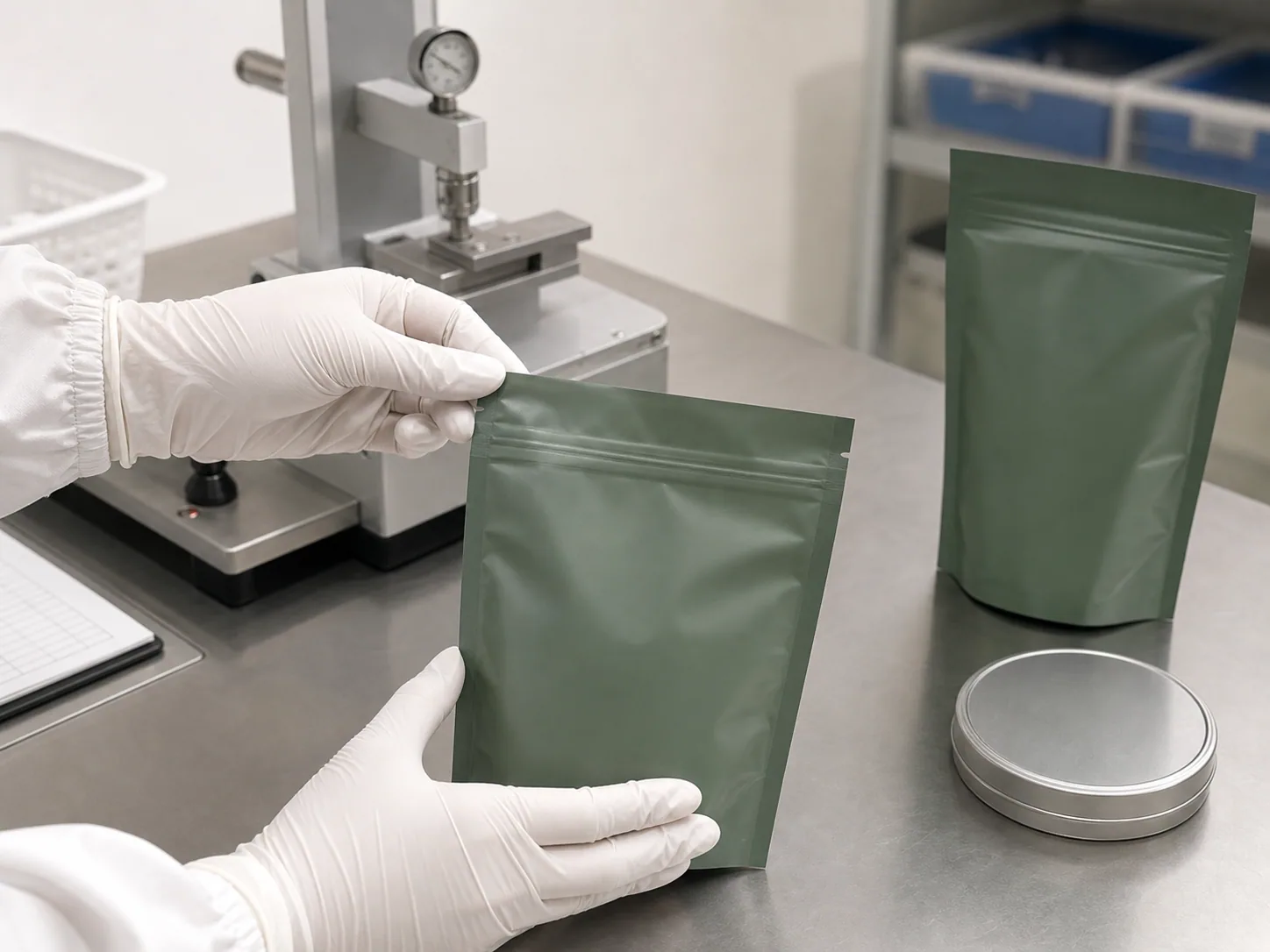
Barrier and Performance Testing When Relevant
Barrier testing may be appropriate when product sensitivity and the approved structure make oxygen or moisture transmission important. Oxygen transmission rate, commonly abbreviated OTR, describes oxygen passing through a material under specified test conditions. Water vapor transmission rate, or WVTR, addresses water vapor transmission under stated conditions. The method, temperature, humidity, specimen and reporting basis matter when results are compared.
A barrier value does not by itself guarantee product shelf life. Shelf life can also be affected by the product, filling process, residual oxygen, package seals, closures, storage, distribution, light, temperature and interactions among these factors. Buyers should use product-specific technical review and suitable validation instead of treating a material data point as a complete shelf-life promise.
Other project-specific evaluations may include seal strength, leak integrity, drop or distribution testing, and package fit or function. The correct test depends on the failure risk and intended distribution environment. The barrier structure guide explains why performance requirements should be translated into a complete structure rather than a preferred material name.
Visual and Workmanship Inspection
Workmanship review identifies visible defects that may affect presentation, handling or function. Examples can include scratches, contamination, delamination indicators, wrinkles, poor trimming, damaged edges, inconsistent seals, dents, crushed corners, incorrect components and obvious printing defects.
The applicable defect list should reflect the format. A pouch, folding carton and metal tin do not share every construction feature, and a cosmetic variation that matters on a premium decorative tin may not be evaluated in the same way as a hidden shipping component. Buyers should define which characteristics are critical, major or minor for their project without assuming one classification fits all applications.
Lighting, viewing distance, sample orientation and packaging condition can influence visual inspection. When appearance is important, an agreed reference and consistent review method help reduce disagreements between production, warehouse and receiving teams.
Packaging Function and Fit-for-Use Review
A package should be reviewed in the context of the intended product and handling process. The check may include filling compatibility, opening, dispensing, reclosing, stacking, carton fit, machine handling, product-to-package clearance and the way the finished pack is presented or transported.
Functional approval should use representative conditions where practical. An empty pouch may not reveal how a zipper closes after filling, and a carton without its intended product may not show whether internal clearances are suitable. Buyers should identify the product, fill weight, equipment interface and distribution assumptions that are important to the approval.
For projects involving flexible formats, the Flexible Packaging capability page provides an overview of available structures and customization considerations. The final fit-for-use decision still depends on the approved application and project-specific evaluation.
Sampling, Approval and Production Reference Standards
Samples serve different purposes. A structural prototype may confirm size and usability without representing final printing or materials. A digitally printed sample may support artwork review but differ from the production printing process. A production sample may provide stronger evidence of the intended materials and converting sequence. Buyers should document what each sample represents.
An approved reference sample helps align expectations for appearance, construction and function. It should be identified, dated or otherwise controlled so that the buyer and supplier refer to the same version. However, a sample does not replace measurable specifications when dimensions, material structure, seal performance or other objective requirements matter.
Changes after approval should be recorded. Artwork revisions, material substitutions, tooling changes and component adjustments may require renewed review. The broader sequence from project review through sampling, approval, production and shipment is described on the Packaging Manufacturing page.
Pre-Shipment Inspection
Pre-shipment inspection is an opportunity to compare finished goods with the approved specification before dispatch. Depending on the plan, the review may include workmanship, dimensions, package configuration, approved colors, components, quantity, carton labeling, carton marks and the condition of shipping packs.
A random sample can provide evidence about a production lot, but its meaning depends on the sampling plan and acceptance criteria. The buyer and supplier should agree how samples are selected, which defects or measurements are reviewed, how results are recorded and what happens when a result does not meet the requirement.
No single acceptance quality limit or inspection percentage is appropriate for every packaging program. Product risk, package format, order size, past performance, customer requirements and regulatory context can influence the plan. Transport-related testing should likewise be selected for the intended packaged-product system and distribution environment rather than applied as a generic badge.
Quality Documentation Buyers Should Keep
Clear records support repeat orders and help teams investigate deviations. Useful project documents may include the final specification, approved artwork, controlled sample or reference, purchase requirements, change approvals, inspection records, test reports when applicable, and production or lot references when those identifiers are used.
Documentation should state what was actually evaluated. A material report is not the same as a finished-package test, and a visual inspection record is not proof of barrier or seal performance. Buyers should retain the records needed for their own product, compliance and supplier-management responsibilities.
- Final approved packaging specification and drawing
- Current artwork revision and approval record
- Controlled sample or reference identification
- Inspection results and nonconformance decisions
- Relevant test reports and test conditions, when required
- Approved change records
- Production, lot or shipment references used for traceability
Royal Pack Group’s Quality Control page explains the broader project approach to inspection and process control.
Common Packaging Quality-Control Mistakes
- Approving appearance without a written specification.
- Using vague color expectations without an agreed reference.
- Changing artwork without revision control.
- Checking only finished appearance while ignoring construction.
- Assuming a clean-looking seal proves seal strength or leak integrity.
- Ignoring closure alignment, opening behavior or filled-package function.
- Assuming a stated barrier structure automatically guarantees shelf life.
- Failing to define sampling and acceptance criteria before production.
- Treating every packaging format with the same defect checklist.
- Using a prototype as if it represented every production material and process.
- Reviewing goods only after shipment when a pre-shipment check was expected.
Packaging Quality-Control Checklist
| QC Area | What to Confirm | Why It Matters |
|---|---|---|
| Specification | Approved format, dimensions, materials, components and revision. | Creates the objective basis for inspection. |
| Artwork | Correct file, text, graphics, barcode placement and orientation. | Prevents production from an outdated or incorrect version. |
| Color and print | Agreed reference, registration, consistency and visible defects. | Supports brand presentation and legibility. |
| Dimensions | Defined measurement points and agreed tolerances. | Influences filling, fit, capacity and handling. |
| Material and structure | Approved identity, construction, thickness and finish where relevant. | Supports the intended package performance and appearance. |
| Seals | Continuity, contamination, wrinkles, channels and agreed testing. | Seal defects can affect containment and package integrity. |
| Closures | Correct component, placement, alignment and operation. | Influences opening, reclosing, dispensing and use. |
| Workmanship | Scratches, contamination, trimming, edges, dents and assembly. | Helps identify presentation or functional defects. |
| Function | Representative filling, opening, closing, fit and handling. | Connects the package to its intended use. |
| Performance testing | Applicable method, conditions, samples and acceptance criteria. | Produces evidence relevant to the specified risk. |
| Quantity and labeling | Counts, carton labels, marks and package identification. | Supports receiving, inventory and shipment control. |
| Shipment inspection | Sampling plan, finished goods and shipping-pack condition. | Provides a final review before dispatch. |
| Documentation | Approvals, inspection records, reports and change history. | Supports repeatability and issue investigation. |
This checklist is a planning aid, not a universal inspection standard. Each project should define the applicable requirements and acceptance process.
FAQ
What should be checked during packaging quality control?
The applicable checks may include specification, artwork, print, color, dimensions, material construction, seals, closures, workmanship, function, quantity, labeling and shipment preparation. Performance testing should be added only when relevant to the package and application.
Why is an approved packaging specification important?
The specification defines what has been approved and gives inspection an objective comparison. It can identify dimensions, materials, artwork revision, components, finish, packing method and any agreed tolerances or project-specific requirements.
How should packaging print quality be inspected?
Inspection should confirm the correct artwork revision and review registration, text and graphics, obvious defects, color and consistency against an agreed reference. The review method should reflect the printing process, substrate and finish used for the job.
How can packaging seal quality be checked?
Visual and functional review may identify contamination, wrinkles, channels or inconsistent seals, but visual inspection alone does not prove seal integrity. When required, an agreed seal-strength, leak or other appropriate method should define specimens, conditions and acceptance criteria.
Does every packaging project need barrier testing?
No. Barrier testing may be relevant when oxygen, moisture or another transmission requirement is important to the application and specification. The chosen method and conditions must match the material, package and technical question being evaluated.
What should buyers check before packaging is shipped?
A pre-shipment review may cover workmanship, dimensions, configuration, quantity, carton labels or marks, agreed functional checks and shipping-pack condition. Sampling and acceptance rules should be agreed before production.
What information should I provide when requesting packaging quality requirements?
Provide the package format, dimensions, material or structure if known, intended product and application, order quantity, artwork, closure requirements, quality or testing concerns, distribution conditions and target timing. The project can then be reviewed before any testing or production commitment is made.
Related Packaging Resources
- Pouch Format Selection Guide
- Packaging Barrier Structure Guide
- Flexible Packaging Materials Guide
- Packaging Printing Options Guide
- Quality Control
- Manufacturing
- Flexible Packaging
Request a Quote
To review a packaging project, provide the package format, dimensions, proposed material or structure if known, quantity, artwork status, intended product and application, closure requirements, quality or testing requirements, distribution considerations and target timing. Submit the project through Request a Quote. Testing, inspection and acceptance requirements should be confirmed only after the package and application have been reviewed.