
A useful custom packaging quotation starts with a defined project, not only a request for “custom bags” or a unit price. Buyers do not need every technical answer before the first discussion, but they should provide enough information for the packaging format, dimensions, performance needs, printing, quantities, approvals and delivery requirements to be understood.
This checklist is designed for B2B packaging buyers, procurement teams, sourcing teams, brand owners and product-development teams preparing a new packaging request for quote. It organizes the information that supports a meaningful technical and commercial review while allowing unknown items to be identified for discussion.
Quick Answer: What Should a Packaging Buyer Prepare?
Prepare the information currently available about the product, intended application, packaging format, dimensions, material or barrier objectives, printing, artwork status, total quantity, quantity per SKU, closures or special features, sample and approval requirements, target timing and delivery destination. Clearly mark any item that is not yet decided.
A complete first inquiry does not require the buyer to design the package or select every material independently. It should, however, make clear what is known, what remains open and which decisions are commercially important. This helps separate four different information groups:
- Product requirements: what is being packed and what conditions the package may need to support.
- Packaging specifications: the format, size, structure, printing and features.
- Commercial RFQ information: quantities, SKU count, artwork versions and reorder context.
- Project and delivery requirements: approvals, target timing and destination.
What Is a Packaging Specification?
A packaging specification is the controlled description of the package a buyer intends to source. Depending on the project, it may identify the package format, dimensions, material construction, barrier or performance objectives, printing requirements, closures, finishes, inspection references and approved artwork. A mature specification may be a formal document; an early-stage specification may be a structured list of known requirements and open questions.
The specification is different from the product requirement. “Roasted coffee,” “powdered supplement” or “cosmetic cream” describes the application but not the complete package. It is also different from commercial RFQ information such as total quantity, quantity by design and delivery destination. A useful quote connects all three areas without treating them as interchangeable.
Buyers should identify applicable product, market and regulatory requirements and obtain appropriate specialist review where needed. A packaging discussion can support specification development, but it should not be treated as legal or regulatory certification.
What Information Should Be Included in a Packaging RFQ?
A packaging RFQ should explain the project well enough for the requested package and commercial basis to be reviewed. The exact level of detail depends on whether the buyer has an established specification, a reference sample, an existing package to reproduce or an early concept that still requires format discussion.
At minimum, organize the inquiry around the product and application, package format, size, material or performance needs, print and artwork, quantities, SKU count, features, approval requirements, timing and destination. When an answer is unknown, state that clearly rather than substituting an assumption. Photographs, drawings, approved reference samples and prior specifications may help when they truthfully represent the intended project.
A supplier may ask follow-up questions before confirming feasibility or preparing a commercial proposal. That review is part of defining the project, not evidence that every inquiry must start with a finished engineering specification.
Product and Application Information
Begin with what will be packed and how the package will be used. Useful information may include the product type, physical form where relevant, intended use, filling method if known, storage conditions, distribution environment and the way the package will be displayed or handled. These details help frame the technical discussion without assuming a complete material solution.
Buyers should identify product sensitivities they already know, such as oxygen, moisture, light or aroma exposure, along with puncture, seal or stiffness needs where applicable. Product compatibility, filling conditions and distribution requirements may affect the package structure, but they should be evaluated for the actual application rather than inferred from the product category alone.
Any customer-supplied compliance, testing, labeling or market requirements should be stated separately. Buyers remain responsible for identifying the laws and standards applicable to their product and market and for obtaining appropriate regulatory guidance.
Packaging Format
Identify the intended package format when it is known. Examples may include a stand-up pouch, flat-bottom pouch, side-gusset bag, rollstock, folding carton, rigid box or metal tin. Each format has its own dimensional language, material route, printing surface, filling considerations and possible components.
If the format has not been finalized, provide the product and application, approximate capacity or target size, filling method, shelf and display requirements, opening and reclosing needs, and any structural features under consideration. That information allows format options to be discussed without claiming that one package is universally best.
Buyers comparing common flexible formats can review the Pouch Format Selection Guide. The Flexible Packaging page provides a broader view of available format, material, printing and converting considerations.
Dimensions and Capacity
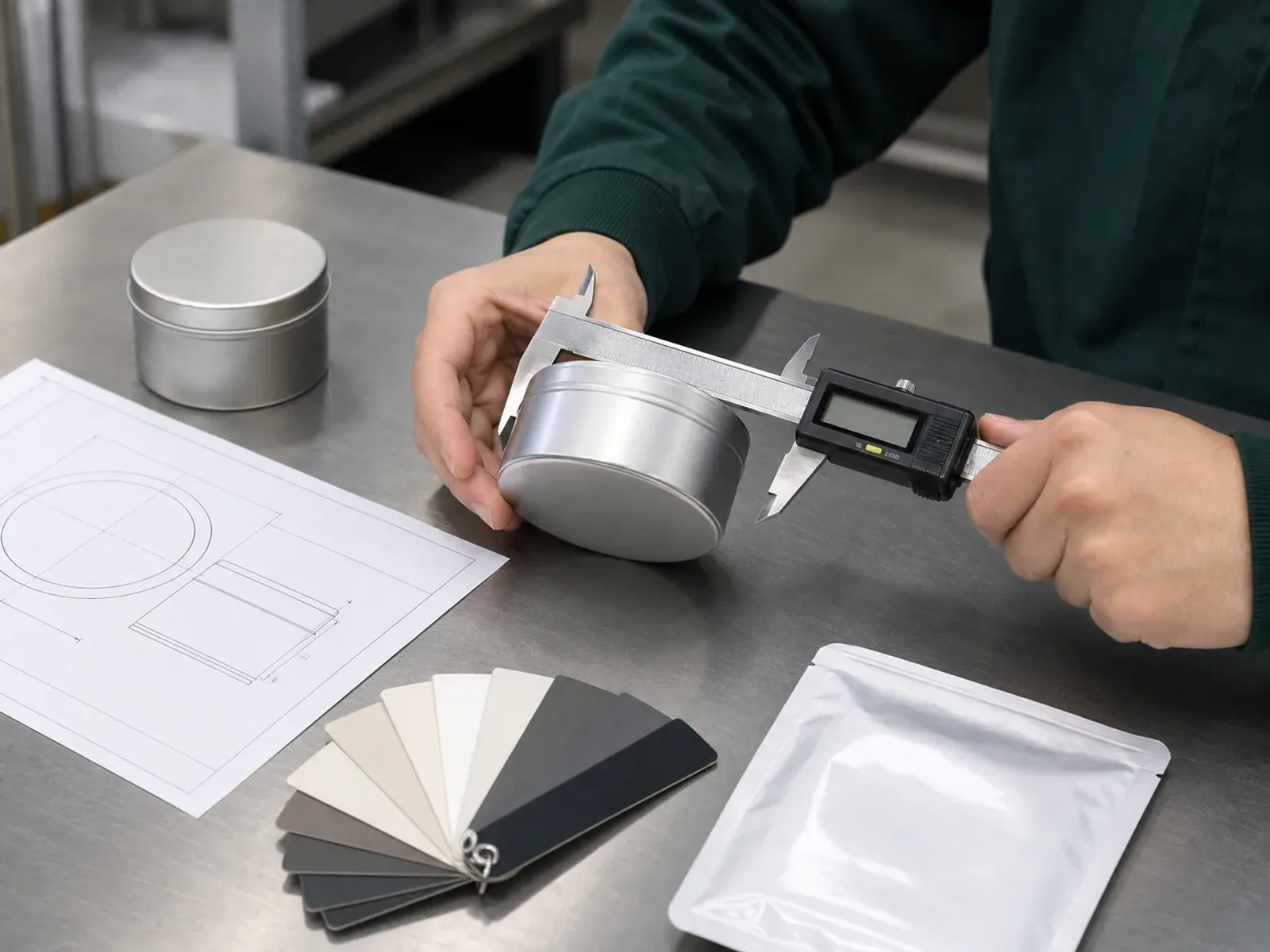
Dimensions affect material usage, dielines, print layout, tooling, filling fit, carton packing and the overall commercial basis. State which package dimension convention is being used. For flexible packaging, the specification may involve width, height, bottom gusset, side gusset, seal areas and closure position where applicable. Other packaging formats use different dimensional definitions.
Do not assume that a nominal capacity defines the finished dimensions. Product density, headspace, filling method, package shape and closure position may influence the required size. When possible, provide an existing approved specification, drawing, physical reference or the product quantity the package must hold so the dimension and capacity discussion has a clear basis.
Dimension tolerances and measurement methods should be project-specific and agreed through the approved specification. This checklist does not create engineering tolerances or a universal measurement convention.
Material and Barrier Requirements
A buyer may provide an existing known material construction or describe the performance objectives the package should support. A known construction can include the material layers, thicknesses, coatings or other approved details. An objective-based request may describe oxygen, moisture, aroma, light, puncture, stiffness, sealability, appearance or product-compatibility needs where relevant.
These two approaches should not be confused. Naming a material does not automatically define the performance of the complete package, and describing a performance need does not by itself approve one laminate. Product characteristics, distribution, filling, storage and expected use should be considered together. No structure should be presented as universally suitable, and shelf life should not be guaranteed from a material name alone.
The Packaging Barrier Structure Guide explains how buyers can move from product and distribution needs to a structure discussion. The Flexible Packaging Materials Guide describes the possible roles of PET, PE, BOPP, foil and paper without assigning universal performance targets.
Printing and Artwork
Provide the number of designs or SKUs, artwork status, expected print coverage, known color requirements, finish requirements and any variable artwork or versioning needs. If a printing method is already specified, identify it and explain the basis. If it is not fixed, provide the volume, artwork, substrate and commercial requirements so available printing routes can be discussed.
Artwork may be final, in development or not yet started. State which condition applies. Production-ready files normally depend on the approved package dimensions and dieline, so changing the structure after artwork preparation can create rework. The buyer should also identify required copy, barcode needs where applicable and the person responsible for approving proofs and final files.
Rotogravure, flexographic and digital printing use different preparation and production routes. No method is always best, cheapest or fastest. The Packaging Printing Options Guide explains the relevant differences without applying a universal ranking.

Quantity, MOQ and Number of SKUs
Total project quantity and quantity per SKU are separate commercial inputs. A program may have one overall volume divided among several designs, sizes, flavors or product variants. Each version can involve its own artwork preparation, proof approval, print setup, production allocation and packing identification.
Provide the estimated total quantity, the quantity for each SKU or design, the number of artwork versions and any expected reorder pattern that may support planning. Do not combine all versions into one total without explaining the split. Likewise, do not assume that one total automatically satisfies the practical minimum for every version.
The Packaging MOQ Guide explains how format, material, printing, tooling, components and quantity per design can affect a practical minimum. This article does not publish a numeric MOQ because the applicable basis depends on the actual project.
Closures, Valves and Special Features
Identify any zipper, tear notch, degassing valve, hang hole, window, spout, handle, fitment or special finish being considered. Provide the intended use, preferred position and approved reference where available. These details can affect dimensions, material compatibility, printing layout, sourcing and converting.
Features are format-specific. A component that is appropriate for one pouch, carton or tin may not be available or technically suitable for another. Buyers should not assume that every feature can be combined with every material or package structure. The intended filling, opening, reclosing, display and distribution requirements should guide the discussion.
Quality and Approval Requirements
Quality requirements should be connected to the approved specification. Project-appropriate references may cover dimensions, material construction, print and color expectations, workmanship, seals, closures, finishes, approved artwork and any customer-specific inspection or release requirement.
State what the buyer expects to approve and who owns the decision. Depending on the project, approval may involve a dieline, artwork proof, structural sample, printed prototype, material reference or agreed inspection information. Not every test or approval type applies to every project, and this checklist does not create AQL values, tolerances, defect limits, inspection percentages or laboratory requirements.
The Packaging Quality Control Buyer Checklist explains how to define inspection references and decision criteria. The Quality page describes the broader quality workflow, while Manufacturing outlines the production sequence from project review through packing and shipment.
Samples and Prototypes
Identify whether the project may require a structural sample, unprinted sample, printed prototype or another agreed approval sample. The sample type should be tied to the question it is intended to answer. A structural sample may support size and fit review, while a printed prototype may support artwork placement or appearance review.
Not every project requires every sample type, and a sample should not be treated as proof of characteristics it was not designed to evaluate. State the sample purpose, required material or printing level, approval criteria and decision owner. Sampling availability and timing remain project-specific; this article does not promise free samples, production samples or a fixed sample schedule.
Project Timing and Delivery Requirements
Provide the target launch date, desired production timing, known approval deadlines, delivery destination and whether the timing is fixed or flexible. A target date is a planning input, not a guaranteed delivery commitment. The project schedule can only be evaluated after the specification, artwork, materials, approvals, production route and shipping requirements are understood.
Separate production completion from dispatch and delivery. Shipping method, destination, shipment size, carrier schedules, customs or import procedures where applicable, and external disruptions may affect transit. Buyers should clarify which milestone a proposed date refers to and avoid treating production readiness as arrival at the destination.
The Packaging Lead Times Guide explains the difference between quotation, pre-production approval, production lead time, shipping time and the total project timeline without publishing a universal schedule.
New Project vs Repeat Order
A new project normally requires the specification, artwork, commercial basis and approval path to be established. A repeat order should identify the previous item or approved specification and confirm whether the artwork, quantity, material, dimensions, features, packing requirements or destination have changed.
“Repeat order” should not be used as a substitute for review. Previous cylinders, plates, tooling, materials or production references may require confirmation before reuse. A change in one SKU, component or destination can affect only part of the program or require a broader commercial and technical review. The RFQ should clearly separate unchanged items from requested revisions.
Packaging Specification Checklist
Use the checklist below to organize the information currently available. Mark unknown items for discussion rather than creating unsupported assumptions.
| Specification Item | Information to Prepare | Why It Matters |
|---|---|---|
| Product / application | Product type, physical form where relevant, intended use, filling and distribution context. | Frames compatibility, handling and performance discussions. |
| Packaging format | Known format or the requirements that format options should support. | Defines the structural and manufacturing route. |
| Dimensions | Width, height, gusset or other format-specific measurements and the convention used. | Supports dielines, material planning, tooling and packing review. |
| Capacity / fill requirement | Target fill quantity, product density or approved reference where relevant. | Helps connect the package size to the actual application. |
| Material structure | Existing approved construction, material preference or an open structure request. | Establishes the basis for technical and commercial review. |
| Barrier requirement | Known oxygen, moisture, aroma, light or other performance objectives where applicable. | Supports evaluation of the complete package structure. |
| Printing | Specified method if any, print coverage, colors, finishes and variable content. | Affects artwork preparation, tooling and production planning. |
| Artwork status | Final, in development or not started; identify the approval owner. | Shows what can proceed and where revisions may be required. |
| Number of SKUs | Count of sizes, designs, flavors or artwork versions. | Defines versioning, proofing and production coordination. |
| Quantity per SKU | Estimated quantity for each design or version. | Supports a realistic commercial basis for every SKU. |
| Total quantity | Estimated combined project quantity. | Provides program-level sourcing and production context. |
| Closures / features | Zipper, valve, window, spout, handle, hang hole, finish or other relevant component. | May affect compatibility, sourcing, dimensions and converting. |
| Sample requirement | Purpose and type of structural, unprinted, printed or other approval sample. | Defines what must be demonstrated before approval. |
| Quality / approval requirement | Approved references, inspection expectations and decision owner. | Establishes the basis for review and release decisions. |
| Target timing | Launch objective, approval deadlines and whether timing is fixed or flexible. | Supports project planning without creating a delivery guarantee. |
| Delivery destination | City, country or agreed destination detail appropriate for quotation. | Supports packing, shipping and commercial review. |
| New / repeat project status | Previous item reference and a list of unchanged or revised requirements. | Shows what can be reviewed against an existing approval. |
Example of a Well-Prepared Packaging RFQ
Illustrative Example
The fictional outline below demonstrates how a buyer can organize an inquiry. It is not a Royal Pack Group customer order, price, minimum quantity, material recommendation or production commitment.
- Product: [Generic product type and physical form]
- Application: [Filling, storage, display and distribution context]
- Format: [Known format or formats under consideration]
- Size: [Format-specific dimensions and target fill requirement]
- Material / barrier objective: [Existing structure or required performance objectives]
- Printing: [Artwork coverage, color or finish expectations; method if specified]
- Designs: [Number of SKUs or artwork versions]
- Quantity: [Estimated total and quantity for each SKU]
- Features: [Required closure, valve, window or other applicable component]
- Artwork: [Final, in development or not started]
- Sample requirement: [Purpose and requested sample type, if any]
- Quality / approval: [Known reference, approval step and decision owner]
- Target timing: [Launch objective and known approval deadlines]
- Destination: [Delivery location appropriate for quotation]
This structure makes unknown items visible and gives the buyer and supplier a shared starting point. It does not make every field mandatory or predetermine the final package specification.
Common Packaging RFQ Mistakes
- Requesting a price without package dimensions or a capacity basis.
- Providing a total quantity without the quantity for each SKU or design.
- Using a product category as if it were a complete package specification.
- Leaving the packaging format unclear without describing the intended application.
- Not stating whether artwork is final, changing or not yet started.
- Omitting closures, valves, windows or special finishes from the initial request.
- Changing materials or dimensions after quotation without requesting a revised review.
- Confusing a target delivery date with production completion.
- Omitting the delivery destination from the commercial inquiry.
- Assuming an old specification, artwork or tooling remains unchanged and reusable.
FAQ
What information is needed for a packaging quote?
Provide the information currently available about the product, package format, dimensions, material or barrier requirements, printing, artwork status, total quantity, quantity per SKU, number of designs, closures or features, sample and approval requirements, target timing and delivery destination. Clearly identify any item that remains open for discussion.
Do I need a finished packaging specification before requesting a quote?
Not always. An established specification can support a direct review, but an early-stage buyer may provide the product and application, target size, filling method, performance objectives, quantity, artwork status, features and project requirements so the missing specification decisions can be identified. A quotation may require follow-up before the commercial basis is complete.
What packaging dimensions should I provide?
Use the dimension convention for the specific package format and state how each measurement is defined. Flexible packaging may involve width, height, bottom or side gussets, seal areas and closure position where applicable. Other formats use different measurements, so a drawing, approved specification or reference sample may help prevent ambiguity.
Do I need to know the exact material structure?
No. A buyer may provide an existing approved construction or describe relevant performance objectives such as oxygen, moisture, aroma, light, puncture, stiffness, sealability, appearance or product compatibility. The final structure should be evaluated for the actual product, filling, storage and distribution conditions rather than selected from a universal recommendation.
How should I provide quantities for multiple SKUs?
State the estimated total project quantity and the quantity for each SKU or artwork version. Also identify the number of designs, sizes or variants and any expected reorder pattern that may support planning. One combined total does not show the production basis for every version.
Should artwork be finished before requesting a packaging quote?
Final artwork is not always required for an initial discussion, but buyers should state whether artwork is final, in development or not started and provide the number of designs, expected print coverage, colors and finishes where known. Production artwork normally depends on an approved format, dimensions and dieline.
What should I provide if I need packaging by a specific date?
Provide the target launch or delivery objective, known approval deadlines, production timing expectations, destination and whether the date is fixed or flexible. Timing must be reviewed against specification completion, materials, artwork, samples, approvals, production and transit. A target date is not a guaranteed delivery date.
Related Packaging Guides
- Pouch Format Selection Guide
- Packaging Barrier Structure Guide
- Flexible Packaging Materials Guide
- Packaging Printing Options Guide
- Packaging Quality Control Buyer Checklist
- Packaging MOQ Guide
- Packaging Lead Times Guide
- Flexible Packaging
- Manufacturing
- Quality
Request a Quote
To discuss a custom packaging project, provide the information currently available. Useful starting details include the packaging format, dimensions, material or barrier requirements, total quantity, quantity per SKU, number of designs, printing and artwork status, closures or special features, sample or approval requirements, target timing and delivery destination.
Unknown items can be identified for discussion rather than treated as mandatory answers. Submit the project through Request a Quote so the technical and commercial requirements can be reviewed against the actual application.