
Coffee packaging should be specified around the coffee, filling operation and complete distribution system—not selected by pouch appearance alone. Whole-bean coffee, ground coffee and other dry coffee products can create different requirements for package geometry, barrier, degassing, closure, sealing, printing and production planning.
A useful B2B specification defines what is known and identifies what still requires review. Buyers can begin with the coffee format, fill weight, preferred pouch style, dimensions, barrier objectives, valve requirement if known, closure, printing, SKU count, quantity, filling process, target timing and delivery destination. The final construction should remain project-specific.
Quick Answer: How Should Buyers Choose Coffee Packaging?
Start with the product and operating requirements. Describe whether the coffee is whole bean, ground or another dry coffee product; when it will be packed relative to roasting; how it will be filled and sealed; how much product the package will contain; and how it will be stored, shipped, displayed and opened.
Then compare pouch formats, material and barrier objectives, valve needs, closures, print requirements and production variables. A stand-up pouch, flat-bottom pouch and side-gusset bag can each support effective coffee packaging when correctly specified, but no one format, material recipe or valve arrangement is universally best.
Buyers do not need every technical answer before starting a discussion. Provide the information currently available and identify unresolved items for engineering and commercial review.
Why Coffee Packaging Selection Starts With the Product
“Coffee” is not a complete packaging specification. Whole beans and ground coffee can differ in particle behavior, filling, package settling and gas-release characteristics. Roast profile, time between roasting and packing, fill weight, target dimensions, opening frequency and distribution plan may also affect the packaging discussion.
Freshly roasted coffee can release gases after roasting. The amount and timing are not identical for every product or process, so degassing should be evaluated rather than assumed. At the same time, oxygen, moisture, aroma and light considerations may influence the complete package specification according to the product and target requirements.
The frozen Coffee Packaging industry page presents Royal Pack Group’s commercial coffee-packaging capability. This guide serves a different purpose: helping B2B buyers organize the technical and commercial decisions behind a coffee pouch RFQ.
Main Coffee Packaging Decisions at a Glance
- Product: whole bean, ground coffee or another dry coffee product, plus relevant roast and packing information.
- Fill: fill weight, bulk behavior, filling method and expected filled dimensions.
- Format: stand-up, flat-bottom, side-gusset or another supported flexible format.
- Barrier: product-specific objectives for oxygen, moisture, aroma and light where relevant.
- Degassing: whether a valve or another validated process approach should be evaluated.
- Closure: initial production seal and any consumer reclosure requirement.
- Graphics: printing, finish, panel layout, barcode and SKU differentiation.
- Production: quantity per SKU, approvals, filling compatibility, secondary packing, schedule and destination.
These decisions interact. Changing pouch geometry can affect dimensions, printable panels, zipper and valve position, filling behavior, case packing and artwork. Changing material construction can affect printing, converting, sealing and barrier performance.
Coffee Pouch Format Options
Common coffee pouch discussions often center on stand-up pouches, flat-bottom pouches and side-gusset bags. Each has a different geometry, but geometry alone does not establish barrier, seal quality, minimum order quantity, cost or lead time.

The Pouch Format Selection Guide provides a broader comparison. Coffee buyers should apply that framework to their actual fill weight, dimensions, valve and closure requirements, equipment, artwork and distribution system.
Stand-Up Pouches
A stand-up pouch uses a bottom gusset designed to support the package when appropriately filled. Buyers may consider this format for retail presentation, multiple fill weights, zipper options, tear notches and a valve where the complete coffee project supports those features.
Important questions include how the pouch will open for filling, how the bottom gusset behaves at the intended fill, where the zipper and valve will sit, how much headspace is required, and how the finished package will fit into a secondary carton. The available printable area must account for seals, gussets and components.
A stand-up pouch is not automatically the lowest-MOQ, fastest or best-barrier choice. Those outcomes depend on the full specification and production route.
Flat-Bottom Pouches
A flat-bottom pouch uses a formed base with front, back and side panels. Its geometry can support a defined shelf footprint and multiple artwork panels, but the buyer still needs to confirm filled shape, dimensions, sealing, closure, valve position and case-packing requirements.
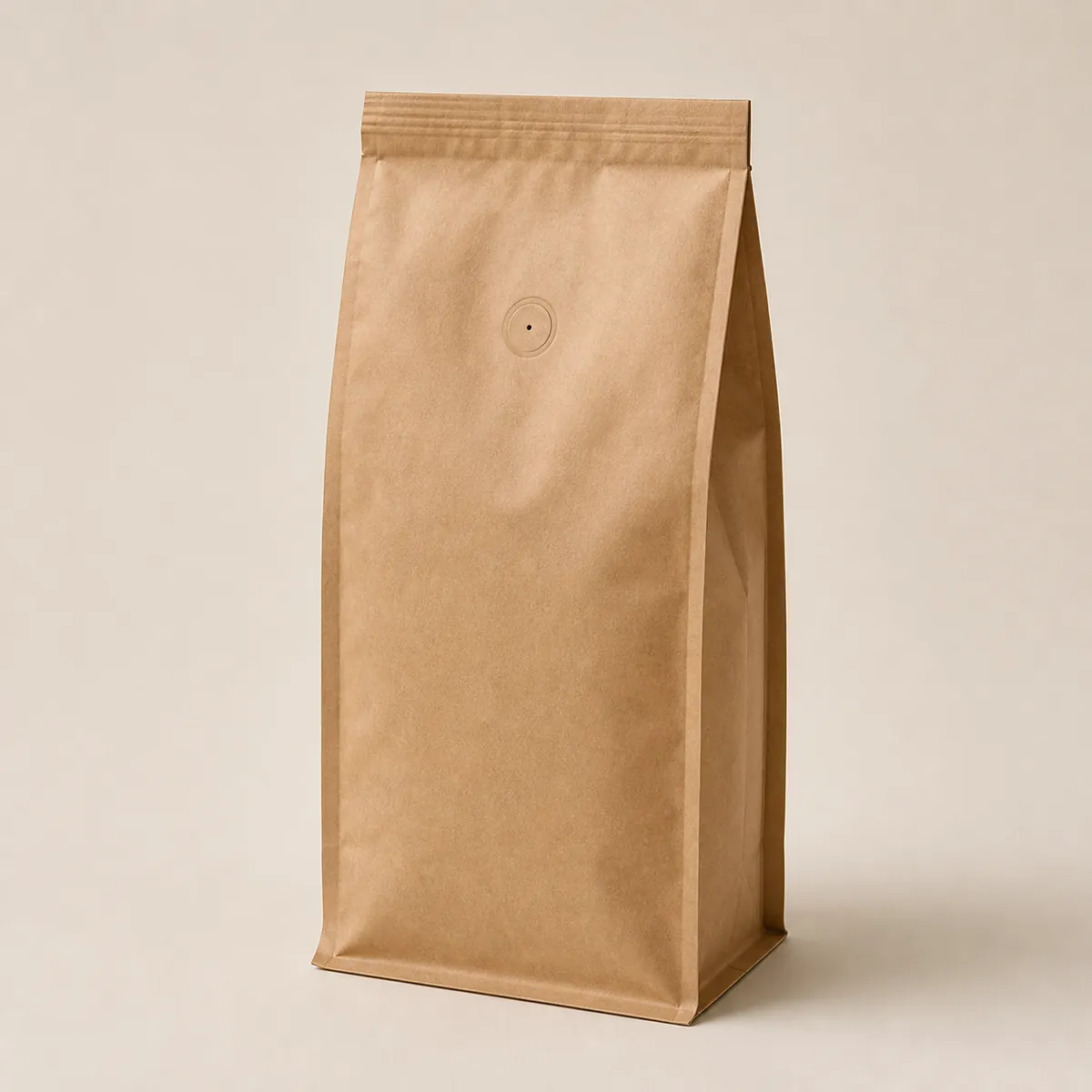
Flat-bottom construction is sometimes chosen for presentation or pack geometry, but “premium” is a brand and project judgment rather than a technical guarantee. The format does not by itself create a particular barrier level or product-protection result.
Side-Gusset Bags
A side-gusset bag expands along the side panels as it is filled. Buyers may evaluate it for whole-bean or ground-coffee programs where the geometry, filling method, package size and presentation fit the project.
Key considerations can include top or bottom closure approach, fold and gusset behavior, valve placement where applicable, printable panels, filled-package stability and secondary packing. A side-gusset format should not be assumed to be cheaper, simpler or more protective than another format without comparing complete specifications.
Other Applicable Flexible Formats
Other supported options may include flat pouches or rollstock when the product and packing operation make them appropriate. Rollstock can be relevant to form-fill-seal operations, while preformed pouches follow a different filling and handling route. Equipment fit must be evaluated against the selected web or pouch dimensions, material, seals and components.
Rigid formats such as metal tins may also appear in coffee programs, particularly when a project calls for a formed package, lid system or presentation role. Buyers considering that route can review Metal Tins vs Flexible Pouches. Neither structure is a universal winner; the product, closure, barrier, packing and distribution system determine suitability.
Barrier Requirements for Coffee Packaging
Coffee projects may require review of oxygen exposure, moisture, aroma and light according to the product and intended distribution. Seal integrity, closure and valve behavior can also influence the complete package system.
Barrier performance is not simply the marketing name of one material. It can depend on individual layers, thicknesses, coatings, metallization, foil where applicable, adhesives and lamination, seal areas, zipper, valve, package geometry and converting quality. The finished package must be evaluated as a system.
Buyers may provide an existing approved structure or describe the performance objectives that are known. The Packaging Barrier Structure Guide explains how product sensitivity, filling, distribution and target requirements shape the discussion.
No universal OTR, WVTR, oxygen threshold, moisture threshold or shelf-life number should be assigned merely because the product is coffee. Any required target must come from the specific project and an appropriate validation plan.
Coffee Packaging Material Structures
Flexible coffee packaging can use combinations of materials selected for printing, stiffness, barrier, sealing, appearance, converting and product compatibility. Depending on the project, the discussion may include PET, PE, BOPP, metallized films, aluminum foil or paper-containing constructions.
These material families are not interchangeable. Metallized film and aluminum foil are different components. A paper appearance does not prove that a pouch is paper-only, and a package that looks recyclable should not be represented as recyclable without accurate structure and market-specific recovery evidence.
Instead of relying on one universal recipe, define the coffee product, pouch format, filling process, barrier objectives, printing, seal, valve, closure, distribution and applicable requirements. The Flexible Packaging Materials Guide explains common material roles without prescribing a laminate for every coffee project.
Degassing Valves: When Buyers Should Evaluate Them
Freshly roasted coffee can release carbon dioxide after roasting. Depending on the coffee, packing timing, package structure and process, gas accumulation can become a packaging consideration. Some coffee packaging systems therefore evaluate a one-way degassing valve as part of the complete design.
A valve is not automatically required for every whole-bean or ground-coffee package. Suitability can depend on the product, roast and degassing behavior, timing between roasting and packing, fill weight, package volume, barrier structure, closure, storage and distribution. Other process choices may also affect the specification.
A valve does not by itself guarantee freshness, shelf life, an airtight package or a specific barrier level. Valve selection, placement and application must be evaluated with the material structure, pouch geometry, seals, filling operation and quality requirements. No opening pressure, closing pressure, gas-transmission value, installation speed or machinery compatibility is assumed in this guide.
Closures and Resealability
The initial production seal and consumer reclosure serve different functions. A zipper may help a consumer close the package after opening, but it is not the original package seal and should not be treated as a guarantee of hermetic performance or barrier.
Buyers should consider package size, single-use or repeated opening, zipper position, fill clearance, tear notch, top-seal area, valve position and how consumers will access the product. Not every coffee pouch needs a zipper, and not every zipper configuration fits every pouch or filling operation.
Seal Integrity and Converted Package Quality
Package performance depends on more than film selection. Seal design, seal-area condition, contamination introduced during filling, pouch conversion, zipper and valve components, handling and inspection can all influence the result.
Buyers should define the approved dimensions, material specification, component positions, workmanship expectations and project-specific inspection criteria. The Packaging Quality Control Guide provides a buyer framework without inventing universal seal-strength values, tolerances, defect limits or sampling plans. Royal Pack Group’s Quality page outlines the broader inspection and approval workflow.
Printing and Brand Presentation
Coffee artwork should be developed on the approved pouch geometry. The design must account for front and back panels, side panels or gussets, bottom area, seal zones, zipper, tear notch, valve, barcode and other required information.

Useful RFQ information includes artwork status, number of colors if known, print coverage, finish, number of SKUs, quantity per SKU and any required versioning. The Packaging Printing Options Guide explains why substrate, artwork, quantity and production requirements matter. No printing process is universally superior, lowest-cost or fastest, and exact color should not be guaranteed without an approved standard and control method.
Filling and Packing Considerations
Packaging specifications should be evaluated against the buyer’s actual filling and packing process. A preformed pouch must be stored, opened, filled and sealed as part of one operating route. Rollstock is formed and sealed through different equipment and controls.
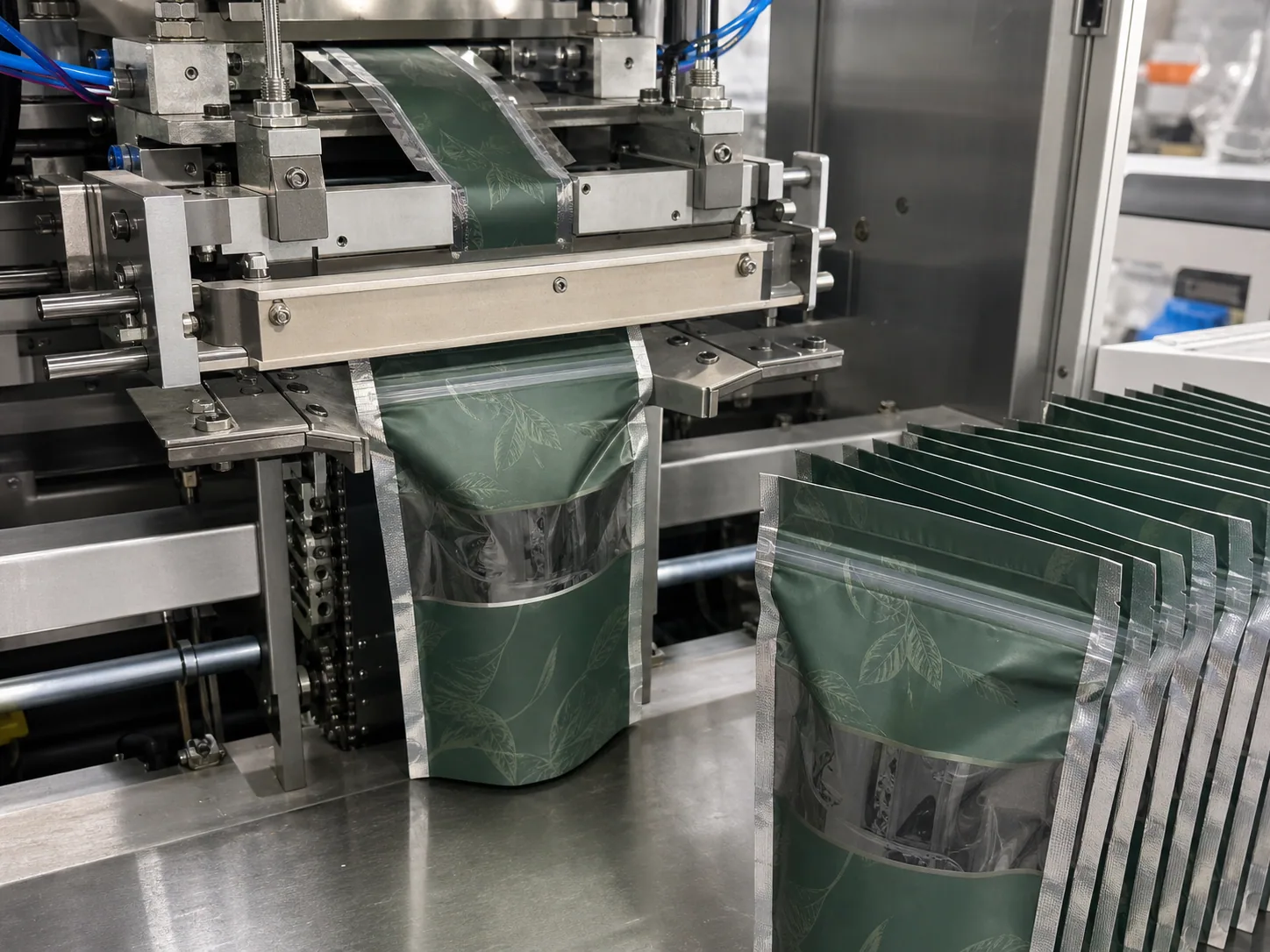
Buyers should provide available information about manual or automated filling, package presentation to equipment, fill weight, dimensions, zipper and valve, seal-area contamination risk, orientation, case packing and finished-package handling. Compatibility with a specific machine, speed or sealing condition should not be assumed until the actual package and process requirements are reviewed.
The Manufacturing page describes Royal Pack Group’s broader workflow from project and engineering review through sampling, production, inspection, packing and shipment coordination.
Secondary Packaging, Storage and Distribution
Coffee packaging planning continues after the pouch is sealed. Buyers should consider storage of empty packaging, finished pack dimensions, secondary cartons, dividers where needed, case packing, palletization, handling, destination and distribution environment.
Filled pouch geometry affects how units fit into cases and how cases stack. Valve and closure areas should not be exposed to avoidable pressure or abrasion. The final transport system—not the primary pouch alone—supports protection through storage and shipment.
No fixed freight savings, carbon savings or sustainability ranking should be inferred from package format alone. Those conclusions require project-specific material, weight, cube, transport and recovery information.
MOQ, SKU Count and Production Planning
Buyers should separate total project quantity from quantity per SKU or artwork. A total order divided across several coffees, sizes or designs can create different printing, setup, component, approval and production requirements than one design at the same total quantity.
Pouch format, dimensions, material construction, printing, valve, zipper, number of SKUs, quantity per SKU, tooling where applicable, approvals and scheduling can all influence minimum quantities. The Packaging MOQ Guide explains these drivers without publishing one fixed number.
Lead time can include specification review, artwork, samples, approvals, material preparation, printing, converting, component application, inspection, packing and shipping. Use the Packaging Lead Times Guide to plan project dependencies without treating a target launch date as a guaranteed delivery date.
Coffee Packaging Format Comparison
This table is a starting framework, not a universal ranking. Typical applications are illustrative, and final suitability depends on the coffee, fill, dimensions, material structure, valve, closure, packing and distribution requirements.
| Format | Structural Characteristics | Buyer Considerations | Typical Coffee Applications |
|---|---|---|---|
| Stand-up pouch | Flexible pouch with a bottom gusset designed to support the filled pack. | Fill behavior, base geometry, zipper and valve position, printable area, top seal and case packing. | Illustrative retail whole-bean or ground-coffee programs across project-specific sizes. |
| Flat-bottom pouch | Formed base with front, back and side panels. | Filled footprint, panel alignment, component position, dimensions, filling and secondary cartons. | Illustrative programs seeking defined shelf geometry and multiple artwork panels. |
| Side-gusset bag | Flexible bag that expands along side gussets when filled. | Top or bottom closure route, gusset behavior, valve position, filled stability and case packing. | Illustrative whole-bean or ground-coffee programs where the geometry fits the filling route. |
| Flat pouch | Flexible format without a stand-up base. | Portion size, fill, seals, opening, display and secondary presentation. | Illustrative sample, portion or specialty dry-coffee applications where appropriately specified. |
| Rollstock | Printed web formed and sealed by compatible packaging equipment. | Machine and web compatibility, repeat length, material, sealing, registration and operating process. | Illustrative automated programs with an established form-fill-seal route. |
Illustrative Coffee Packaging Scenarios
These examples demonstrate decision processes only. They are not Royal Pack Group customer projects, case studies, validated performance results or guaranteed recommendations.
Small Specialty Roaster With Several SKUs
The buyer might compare a stand-up pouch and flat-bottom pouch after defining fill weights, artwork versions, quantity per SKU, packing method and whether a valve or zipper should be evaluated. Consolidated total volume would not remove the need to understand each SKU’s setup and production requirements.
Larger Whole-Bean Coffee Program
Possible considerations include coffee degassing behavior, packing timing, valve requirement, pouch geometry, automated handling, material and barrier objectives, case packing and distribution. The final structure would depend on the validated product and process requirements.
Ground Coffee Product
The buyer might evaluate powder behavior, fill accuracy, seal-area contamination risk, package opening, barrier objectives, closure and consumer use. A valve should not be assumed solely because the product is coffee.
Presentation-Focused Retail Coffee
The buyer might compare format geometry, panel layout, finish, print coverage and secondary presentation while separately defining product protection, sealing and packing requirements. Premium appearance would not be treated as proof of superior barrier or shelf life.
Transition From an Existing Pouch
The buyer could provide a physical sample, prior specification, artwork, dimensions, material details if known and a list of requested changes. Material, valve, closure, size or supplier changes would require review rather than an assumption that every previous production element can be reused.
Coffee Packaging Buyer Specification Checklist
Provide the information currently available. Unknown technical items can be identified for discussion; buyers do not need to complete every field before contacting Royal Pack Group.
| Specification Item | Information to Provide | Why It Matters |
|---|---|---|
| Coffee product | Whole bean, ground or other dry coffee product. | Frames filling, degassing and package-use considerations. |
| Roast and packing context | Available roast information and expected time between roasting and packing. | Supports project-specific degassing review. |
| Fill weight | Target net weight for each size. | Influences dimensions, filled geometry and handling. |
| Target dimensions | Width, height, gussets and measurement convention where known. | Defines package geometry and equipment fit. |
| Pouch format | Preferred format or formats under consideration. | Shapes filling, shelf footprint, panels and seals. |
| Existing material | Current or approved structure if available. | Provides a technical comparison baseline. |
| Barrier objectives | Known oxygen, moisture, aroma or light requirements. | Guides structure discussion without assuming a recipe. |
| Valve | Required, not required or to be evaluated. | Affects package system, placement and converting. |
| Closure | Zipper, tear notch or other supported feature where relevant. | Influences opening, reclosure, artwork and seals. |
| Seal requirements | Known seal areas, process constraints and inspection needs. | Supports filling and package-integrity planning. |
| Printing | Print method if fixed, colors if known and coverage. | Influences production route and artwork preparation. |
| Finish | Matte, gloss or other supported requirement. | Defines appearance and production specification. |
| Artwork status | Concept, in development or production-ready files. | Supports approval and schedule planning. |
| Number of SKUs | Total coffees, sizes and artwork versions. | Identifies project complexity. |
| Total quantity | Estimated total project volume. | Supports commercial and production planning. |
| Quantity per SKU | Estimated quantity for each design and size. | Clarifies setup and run requirements. |
| Filling method | Manual, automated, preformed-pouch or rollstock route. | Connects the package to the operating process. |
| Packing equipment | Available machine and interface information. | Supports compatibility review without assumptions. |
| Secondary packaging | Cartons, dividers, multipacks or other known components. | Influences protection and packing density. |
| Case packing | Units per case and orientation if established. | Connects finished dimensions to distribution. |
| Distribution | Storage and handling environment where known. | Frames package and transport requirements. |
| Target timing | Launch target and approval deadlines. | Supports realistic dependency planning. |
| Destination | Required delivery location. | Supports packing and shipment coordination. |
| Existing sample | Prior pouch, approved sample or specification if available. | Helps distinguish repeat requirements from proposed changes. |
Common Coffee Packaging Selection Mistakes
- Choosing pouch style before defining the product, fill and operating requirements.
- Treating a material name as a complete barrier specification.
- Assuming every coffee pouch needs the same valve configuration.
- Treating a zipper as the original package seal.
- Ignoring filling-equipment and seal-area constraints.
- Finalizing artwork before confirming pouch geometry and component positions.
- Providing total quantity without quantity per SKU.
- Treating MOQ as one fixed supplier number.
- Planning launch timing without specification, sample and approval steps.
- Assuming premium appearance proves better product protection.
Frequently Asked Questions
What type of pouch is commonly used for coffee packaging?
Stand-up pouches, flat-bottom pouches and side-gusset bags are commonly evaluated, but no format is universally suitable. The choice should reflect the coffee product, fill weight, dimensions, filling process, valve and closure needs, printing, secondary packing and distribution requirements.
How do I choose between a stand-up, flat-bottom and side-gusset coffee bag?
Compare filled geometry, shelf footprint, equipment handling, gussets, seal areas, printable panels, zipper and valve position, dimensions and case packing. The best fit is the format that works with the complete product and production specification rather than appearance alone.
What barrier properties should be considered for coffee packaging?
Depending on the project, buyers may need to evaluate oxygen, moisture, aroma and light objectives together with seals, closure, valve, package geometry and distribution. Required performance should be defined for the specific coffee and validated package system; a material name alone is not a barrier specification.
Does every coffee bag need a degassing valve?
No. Freshly roasted coffee can release gases, but valve suitability depends on the coffee, roast and packing timing, fill, package structure, process and distribution. A valve should be evaluated as one part of the complete system and does not guarantee freshness, shelf life or barrier.
What materials are used for coffee pouches?
Projects may discuss PET, PE, BOPP, metallized films, aluminum foil or paper-containing constructions according to printing, stiffness, barrier, sealing, appearance and compatibility requirements. No single laminate recipe is appropriate for every coffee pouch.
What information should I provide for a custom coffee packaging quote?
Provide the information currently available about the coffee, fill weight, format, dimensions, existing material or barrier objectives, valve, closure, printing, finish, SKUs, quantity per SKU, filling method, timing and destination. Clearly identify items that are still open.
Can Royal Pack Group help if I do not yet know the final pouch structure?
Buyers can begin with the product, intended use, preferred format if known, filling process, performance objectives, dimensions, quantity and other available requirements. Material and construction options can then be discussed for the project while the buyer identifies applicable product and regulatory requirements.
Related Packaging Guides
Continue with the Packaging Printing Options Guide, Packaging Quality Control Guide, Packaging Specification Checklist and the broader Food Packaging Materials & Formats Guide. The Flexible Packaging capability page provides additional pouch, material and customization context.
Prepare a Coffee Packaging RFQ
A useful coffee packaging RFQ may include the product type, fill weight, preferred format, dimensions, existing structure if known, barrier objectives if known, valve and closure requirements, printing, finish, quantity, quantity per SKU, number of artworks, filling method, secondary packaging, target timing and destination.
If the final material structure, barrier target or pouch format is not yet determined, provide the information currently available. To begin a project discussion, Request a Quote. No price, fixed MOQ, turnaround time or technical-performance result is guaranteed by submitting an inquiry.