
Food packaging selection should begin with the product, filling process and complete distribution system—not with appearance alone. Flexible pouches, metal tins and paper packaging each provide different structural, presentation and production characteristics, but no format is universally suitable for every food application.
B2B buyers can make a more useful comparison by defining the product’s physical form, fill weight, dimensions, barrier objectives, closure, packing method, quantity, SKU count, distribution route and applicable product or regulatory requirements. When some information is still unknown, identify the open questions instead of assuming that one familiar material or package will solve every requirement.
Quick Answer: How Should Buyers Select Food Packaging?
Start by describing what the package must do. Identify the product, how it will be filled, the protection and barrier objectives, how consumers will open or use the package, how the finished pack will be stored and shipped, and how the project will be produced across all SKUs.
Then compare practical format families. Flexible packaging may support multiple pouch and rollstock configurations with project-specific material structures. Metal tins provide a formed rigid package with a lid or closure developed for the design. Folding cartons, paperboard boxes and rigid boxes may serve primary, secondary, presentation or multipack roles depending on their construction and the product system.
The correct choice remains project-specific. Material and construction requirements should be evaluated for the specific product, intended use, filling conditions, distribution environment and applicable regulatory requirements.
Why Food Packaging Selection Starts With the Product
Two food products that appear similar on a retail shelf may create different packaging requirements. Physical form, oil or grease interaction, fragility, aroma, sensitivity to moisture, oxygen or light, opening frequency and expected handling can all influence the package specification.
The packing operation matters as well. A preformed pouch, formed tin and folding carton enter the filling line differently. The package must work with the planned filling, sealing or closure process, line-side storage, secondary packing and palletization. A design that looks appropriate but does not fit the packing operation can create avoidable engineering, quality and scheduling problems.
Buyers should also identify the intended market and any applicable customer-supplied or regulatory requirements. Royal Pack Group can discuss packaging formats and project specifications, but the buyer remains responsible for defining the product, intended use and compliance requirements that apply to the finished package.
Main Food Packaging Format Families
Royal Pack Group supports food packaging projects across three broad capability families:
- Flexible packaging: pouches, bags and rollstock structures developed around format, barrier, sealing, printing and filling requirements.
- Metal packaging: rigid formed tins in project-specific shapes, dimensions, lid configurations and decorative treatments.
- Paper packaging: folding cartons, paperboard boxes, rigid boxes and other paper-based structures used in primary, secondary, presentation or outer-pack roles where appropriately specified.
The Food & Beverage Packaging page provides the industry context, while the capability pages describe how each packaging family can be configured. Buyers should compare complete systems rather than treating “food packaging” as one material category.
Flexible Pouches and Bags
Flexible food packaging can include stand-up pouches, flat-bottom pouches, side-gusset bags, flat pouches and rollstock where the product and packing route support them. The format influences how the package stands, fills, seals, opens, stores and presents on shelf.

A flexible package is not defined by one universal material. Its performance can depend on the individual layers, thicknesses, coatings, metallization or foil where applicable, adhesive system, sealant layer, closures, valves, package geometry and converted quality. The Pouch Format Selection Guide compares major pouch geometries, while the Flexible Packaging capability page describes broader format and customization options.
Zippers, tear notches, degassing valves or other supported features may be considered where they fit the product, package size and filling process. Not every pouch is resealable, and no closure automatically establishes a required barrier level.
Metal Tins
Metal tins are rigid formed packages that may be produced in round, square, rectangular or specialty shapes according to the approved design and production route. Their structure can support projects that call for defined geometry, a lid-and-body interaction, presentation-oriented packaging or an insert where appropriate.

Food-related application examples can include confectionery, cookies, tea, coffee, mints and gift food packaging. These examples do not mean that every tin construction is suitable for every food. Product compatibility, the complete tin and closure system, filling conditions, secondary packaging and applicable requirements must be evaluated for the project.
The Metal Packaging capability page covers structure and decoration, and Metal Tins vs Flexible Pouches explains how buyers can compare rigid and flexible formats without assuming that one is always more protective, premium or economical.
Paperboard Cartons and Boxes
Paper packaging may include folding cartons, paperboard boxes, rigid boxes, sleeves and other converted structures. Its role can vary. In one project it may be an appropriately specified primary package; in another it may protect or present an inner pouch, tray, liner or container; in another it may function as a multipack or outer carton.

Ordinary paperboard should not be assumed to provide the required moisture, oxygen, aroma, grease or light protection by itself. Board grade, thickness, coatings, liners, inserts, closures, converting and the complete product system all affect suitability.
See Paper Packaging for capability context and Folding Cartons vs Rigid Boxes for a buyer-level comparison of paper packaging structures.
How Product Characteristics Affect Packaging Selection
Useful product information goes beyond a category name. Buyers should describe the product’s physical form and the conditions the package must manage.
- Dry, powdered or granular products: may create dust, flow, seal-area contamination or dispensing considerations depending on the filling method.
- Solid or fragile pieces: may require review of package dimensions, movement, breakage risk and secondary protection.
- Oily or greasy products: may require evaluation of material interaction, surface resistance and sealing conditions.
- Aroma-sensitive products: may require attention to aroma retention or transfer as part of the complete structure.
- Moisture-, oxygen- or light-sensitive products: may require project-specific barrier objectives rather than a generic material name.
Fill weight, portion size, product shape and opening frequency can also influence dimensions, rigidity, closure and user experience. For example, a coffee project may require evaluation of oxygen, moisture, aroma, valve and filling requirements depending on the product and distribution plan; it should not be assigned one mandatory laminate solely because it is coffee.
Barrier Requirements
Barrier is not simply the name of a package material. Actual performance may depend on individual layers, layer thickness, coatings, metallization, foil where applicable, adhesives, seals, closures, valves, package geometry and processing conditions.
For flexible packaging, the buyer may provide an existing approved structure or describe the required performance objectives. The Barrier Structure Guide explains how product sensitivity, filling and distribution requirements shape the discussion. The Flexible Packaging Materials Guide explains common material roles without assigning one laminate to every application.
Required barrier should be defined according to the specific product and target distribution and shelf-life requirements. No fabricated OTR or WVTR target, universal barrier ranking or shelf-life promise should replace project-specific evaluation.
Structure and Physical Protection
Package rigidity and barrier performance are separate questions. A rigid tin or box may provide structural characteristics that differ from a flexible pouch, but rigidity alone does not establish oxygen, moisture, light or aroma protection.
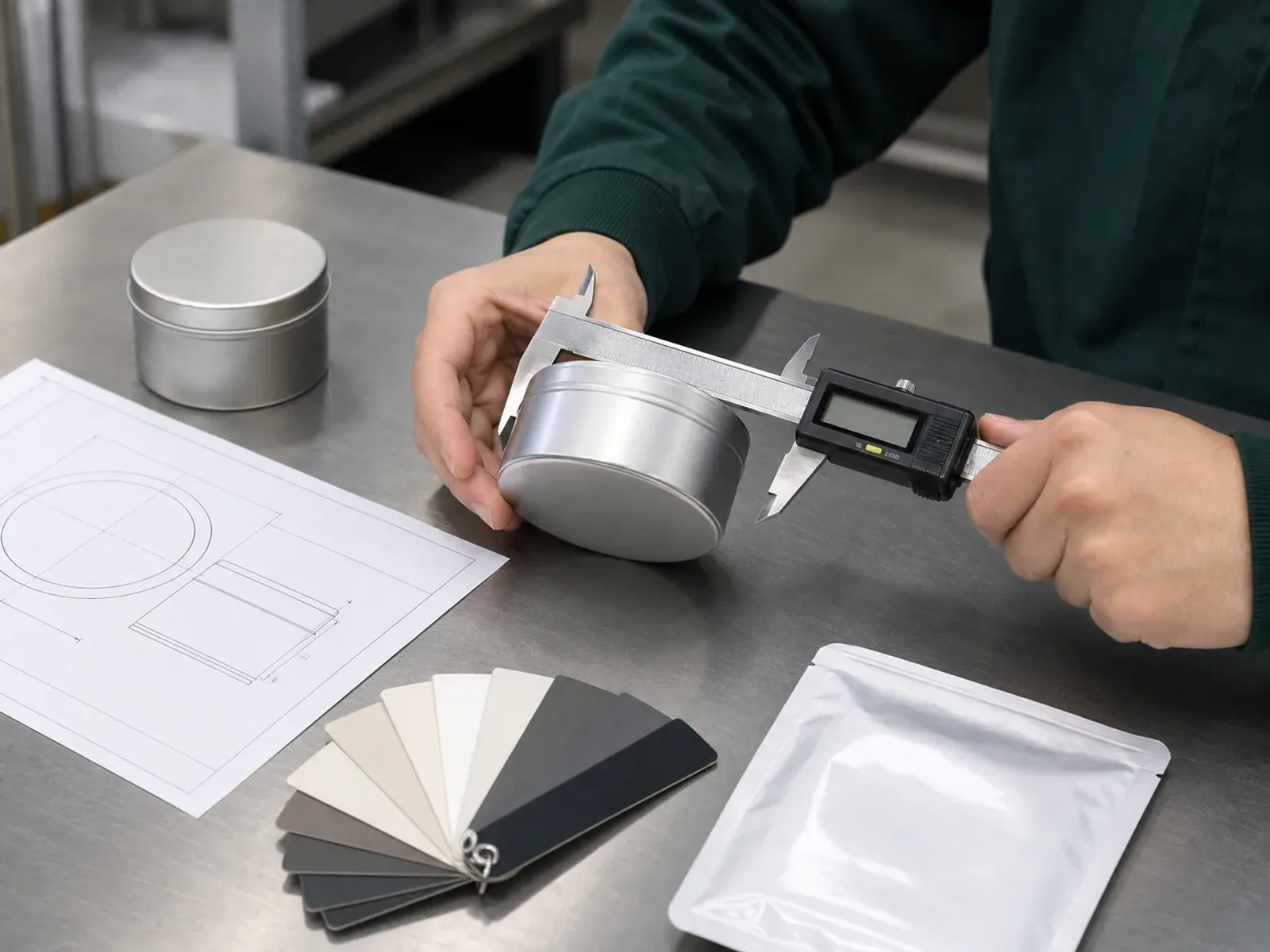
Flexible packages depend on the complete pouch design, material structure, seal integrity, fill condition, secondary cartons and palletization. Metal and paper packages also depend on fit, closure, inserts, joints, secondary packing and the distribution environment. No format is automatically safer or more protective in every application.
Buyers can use the Packaging Quality Control Guide to define measurable dimensions, print expectations, workmanship, seals and project-specific inspection requirements without inventing universal tolerances.
Closures and Consumer Use
Closures should be selected around the package format, product, filling process and intended use. Flexible pouches may support a zipper, tear notch, degassing valve or other compatible feature. Metal tins use project-specific lids or closures. Paper packaging may use tuck, locking or glued structures and may work with an inner package or insert.
Not all pouches are resealable, not all tins are airtight and not all paper boxes are intended to contain the product directly. A closure can support opening, repeated access or packing requirements, but it does not automatically create a particular barrier level or regulatory result.
Printing and Brand Presentation
Food packaging artwork should be planned around the actual structure. Buyers may need to define brand colors, printable area, graphics, information hierarchy, finishes, decoration, SKU differentiation and the number of artwork versions.
Pouch artwork must account for seals, gussets, zipper or valve positions and material behavior. Tin artwork must account for curved or formed surfaces, edges, lids and alignment. Carton artwork must account for panels, folds, glue areas, cut lines and any windows or inserts.
The Packaging Printing Options Guide explains how substrate, coverage, quantity, designs and production requirements affect printing-route selection. No method is universally best, least expensive or fastest, and an exact color match should not be promised without an approved specification and control method.
Filling and Packing Operations
Package selection should account for how the product will actually be packed. Useful questions include whether filling is manual or automated, whether the project uses a preformed package or rollstock, how the package is opened or presented to the filling equipment, and how sealing or closure application occurs.
Product contamination of a seal area, package orientation, closure application, line-side storage, case packing and palletization can all affect feasibility and workmanship. Buyers should provide equipment and process information where available, but no compatibility with a specific machine should be assumed until the selected package and filling requirements are reviewed.
The Manufacturing page outlines the broader workflow from project and engineering review through sampling, production, inspection, packing and shipment coordination.
Storage, Secondary Packaging and Distribution
Food packaging must move through more than the retail shelf. Buyers should consider incoming empty-package storage, line-side handling, finished-package dimensions, secondary cartons, dividers or inserts, case packing, palletization, route and destination.
Many flexible formats have compact empty-package storage characteristics, while formed tins and rigid boxes retain their volume. The final logistics result depends on package size, packing density, filling operation, secondary materials and finished cube. These differences should not be converted into universal freight-saving, carbon-saving or sustainability claims.
Distribution planning should also identify the expected handling environment and damage risks. Total protection depends on the primary package and the complete secondary and transport system.
Quantity, SKU Count and Production Planning
Buyers should distinguish total project quantity from quantity per SKU or design. A project with one total volume divided across multiple artworks can create a different printing, setup, approval and production plan from a single-design project at the same total volume.
Format, dimensions, material structure, printing, closures, components, tooling and sample requirements can all influence minimum quantities. The Packaging MOQ Guide explains these drivers without publishing one universal threshold.
Schedule planning should include specification review, engineering, materials, artwork, samples, approvals, production, quality inspection, packing and shipment. The Packaging Lead Times Guide explains why a target launch date is not a guaranteed delivery date.
Food Packaging Format Comparison
The following table is a starting framework, not a universal ranking. Example applications are illustrative only, and the final specification depends on the product, intended use, filling conditions, distribution environment and applicable requirements.
| Format Family | Structural Character | Typical Buyer Considerations | Example Applications |
|---|---|---|---|
| Stand-up pouch | Flexible pouch with bottom gusset designed to stand when appropriately filled. | Dimensions, fill weight, barrier, seals, zipper or tear notch, shelf presentation and case packing. | Dry snacks, confectionery, powders and specialty foods where the project supports the format. |
| Flat-bottom pouch | Flexible structure with a defined base and multiple printable panels. | Product fit, stiffness, gussets, closure, valve where relevant, filling and shelf geometry. | Coffee, tea, snacks and other dry products as project-specific examples. |
| Side-gusset bag | Flexible bag with side gussets that expand as filled. | Fill behavior, top and bottom seals, closure, valve, dimensions and packing orientation. | Coffee, powders, grains and other compatible dry products. |
| Flat pouch | Flexible sealed format without a stand-up base. | Portion size, opening method, seal area, display method, filling and secondary cartons. | Portions, ingredients, snacks and sample formats where appropriately specified. |
| Rollstock | Printed or unprinted flexible web converted during the buyer’s packing process. | Equipment compatibility, web dimensions, registration, material structure, sealing and line conditions. | Automated food packing applications where the selected machine and structure are compatible. |
| Metal tin | Rigid formed metal body with a project-specific lid or closure. | Shape, dimensions, lid fit, decoration, loading, inserts, secondary packing and complete product system. | Confectionery, cookies, tea, coffee, mints and gift food packaging. |
| Folding carton | Converted paperboard structure supplied flat or preassembled depending on design. | Board, folds, glue areas, inner pack, barrier role, printing, packing and distribution. | Secondary cartons, sleeves, multipacks and selected properly specified primary applications. |
| Rigid box | Formed paper-based presentation structure that retains its shape. | Product fit, inserts, opening method, presentation, secondary packing, storage and shipment. | Gift foods, confectionery assortments and premium presentation programs. |
Illustrative Food Packaging Scenarios
These are illustrative examples, not Royal Pack Group customer projects or mandatory recommendations.
Dry Snack Product
A buyer might evaluate a stand-up pouch, flat pouch or rollstock route after defining portion size, moisture sensitivity, fill method, seal-area conditions, display requirement and secondary carton. The final material structure would depend on the product and distribution plan.
Coffee Product
Possible options could include a flat-bottom pouch, side-gusset bag, stand-up pouch or metal tin. The buyer would need to consider roast and product characteristics, oxygen and moisture objectives, aroma, valve requirements where relevant, filling, closure and the complete distribution system.
Confectionery Gift Program
A buyer might compare a decorated metal tin, rigid box or folding carton used with an appropriate inner package. Product fit, food-contact role, inserts, presentation, opening, secondary packing, SKU count and shipping protection would shape the final system.
Powdered Food
Possible formats could include a compatible pouch, rollstock-produced pack or carton-and-inner-package system. The buyer should define powder flow, dust at the seal area, dispensing or repeated access, barrier objectives, filling equipment and pack-out requirements.
Multi-SKU Specialty Food Brand
The format decision may depend on shared dimensions, different artwork versions, quantity per SKU, printing route, approval workload and reorder plan. A common structure may be considered where products and requirements support it, but it should not be assumed before compatibility review.
Common Food Packaging Selection Mistakes
- Choosing a package by appearance before defining product and process requirements.
- Specifying a material name before defining barrier objectives.
- Assuming package rigidity equals barrier performance.
- Assuming “food packaging” means one universal material or construction.
- Ignoring filling equipment, seal-area conditions or closure application.
- Ignoring secondary cartons, palletization and distribution handling.
- Providing total quantity without quantity per SKU or artwork count.
- Treating MOQ as only a supplier policy rather than a production-planning result.
- Setting a launch date without allowing for specifications, samples, approvals, production and transit.
- Making sustainability claims without evaluating the complete packaging and distribution system.
Buyer Decision Checklist
Provide the information currently available. Buyers do not need every technical answer before starting a packaging discussion, but open items should be identified clearly.
| Question | Information to Define | Why It Matters |
|---|---|---|
| What is the product? | Product type and intended use. | Establishes the application and compatibility context. |
| What is its physical form? | Dry, powdered, granular, solid, oily, greasy, fragile or another relevant condition. | Influences handling, filling, seals and package structure. |
| What is the fill weight or capacity? | Target net contents and expected fill condition. | Supports dimensions, structure and packing review. |
| Which dimensions are required? | Package width, height, gussets, panels or other format-specific measurements. | Defines product fit, filling compatibility and finished geometry. |
| How fragile is the product? | Breakage, crushing, movement or surface concerns. | Frames primary, insert and secondary protection needs. |
| Is moisture sensitivity relevant? | Known product and distribution requirements. | Helps define barrier objectives without guessing a material. |
| Is oxygen sensitivity relevant? | Known product and target shelf-life requirements. | Supports a project-specific barrier discussion. |
| Is light sensitivity relevant? | Known product and display conditions. | May influence opacity, layers or the complete package system. |
| Are oil or grease considerations relevant? | Expected product interaction and handling. | Can affect material, coating, printing and sealing review. |
| Is a barrier target known? | Existing approved specification or performance objective. | Allows technical review without imposing a universal structure. |
| Is package rigidity required? | Required shape retention and physical presentation. | Helps compare flexible, metal and paper structures. |
| Which closure or opening is needed? | Zipper, tear notch, valve, lid, tuck or other supported feature. | Connects consumer use with manufacturing and filling. |
| How will the package be filled? | Manual or automated method, preformed package or rollstock, and relevant equipment information. | Determines whether the selected format can enter the packing process correctly. |
| How will sealing or closure application occur? | Known process and seal-area conditions. | Supports workmanship and process-control planning. |
| What printing is required? | Artwork status, colors if known, coverage, finish and number of designs. | Affects printing route, approvals and production setup. |
| How many SKUs are included? | Number of products, sizes and artwork versions. | Shows how the project volume and approvals are divided. |
| What is the quantity? | Total volume and quantity per SKU. | Establishes the commercial and production basis. |
| What secondary packing is planned? | Inner packs, cartons, dividers, inserts and case configuration. | Connects primary packaging to distribution protection. |
| What distribution environment applies? | Handling, palletization, route and destination. | Supports complete-system protection planning. |
| What is the target timing? | Launch, approval and desired delivery dates, identifying which are fixed or flexible. | Supports scheduling without creating a delivery guarantee. |
| Where will finished packaging be delivered? | Destination and known shipping requirements. | Supports packing, logistics and project coordination. |
RFQ Information to Prepare
A useful food packaging RFQ can include the product and intended application, preferred format if known, dimensions, fill weight, existing material structure or barrier objectives, closure, printing, quantity, quantity per SKU, artwork status, filling and packing process, secondary packaging, target timing and destination.
Provide the information currently available. If the final material structure is not yet specified, describe the product and performance requirements that are known and identify open items for discussion. The Packaging Specification Checklist provides a broader framework for organizing a new B2B project.
Sampling and approval requirements should also be identified where applicable. Not every project needs every sample type, and timing depends on the final format, materials, printing, tooling and approval plan.
Frequently Asked Questions
What packaging materials are commonly used for food products?
Food packaging may use flexible films and laminates, metal constructions, paperboard structures and other project-specific materials. The appropriate choice depends on the product, intended use, filling conditions, barrier and structural objectives, distribution environment and applicable requirements. No material is universally suitable for every food.
How do I choose between a pouch, metal tin and paper box?
Compare the product, fill weight, dimensions, required rigidity, barrier objectives, closure, filling method, shelf presentation, secondary packing, quantity, SKU count and distribution route. Paper packaging may also work with an inner package, while a pouch or tin may serve a different role in the complete system.
How do barrier requirements affect food packaging selection?
Barrier objectives can influence material layers, coatings, metallization or foil where applicable, seals, closures, valves and package geometry. Buyers should provide an existing approved specification or describe the known product and performance requirements. Do not infer barrier or shelf life from a material name alone.
Does a metal tin always protect food better than a flexible pouch?
No. A metal tin provides a rigid formed structure, while a flexible pouch relies on its complete material, seals, format and secondary packaging. Total protection depends on the product, fit, closure, handling, packing and distribution system rather than rigidity alone.
How does filling equipment affect packaging selection?
Filling equipment can affect package dimensions, orientation, presentation to the machine, web or pouch handling, sealing, closure application and line speed requirements. Buyers should provide equipment and process information where available, but compatibility should be confirmed for the selected package and actual operating conditions.
What information is needed to request a food packaging quote?
Provide the information currently available about the product, format, dimensions, fill weight, material or barrier requirements, closure, printing, quantity, quantity per SKU, artwork, filling process, target timing and destination. Clearly identify open items instead of treating every field as mandatory.
Can Royal Pack Group help if the final packaging material is not yet specified?
Buyers can begin a project discussion by providing the product, intended use, preferred format if known, filling process, performance objectives, dimensions, quantity and other available requirements. Material and construction options can then be discussed for the project, while the buyer identifies applicable product and regulatory requirements.
Related Packaging Guides and Request a Quote
Continue the selection process with the Barrier Structure Guide, Flexible Packaging Materials Guide, Packaging Printing Options, Packaging Quality Control Guide and Packaging Specification Checklist. Buyers comparing paper structures can review Folding Cartons vs Rigid Boxes, while buyers comparing rigid and flexible formats can review Metal Tins vs Flexible Pouches.
The Quality page provides context for inspection planning and project controls. To discuss a food packaging project, submit the information currently available through Request a Quote. Unknown items can be identified for review; no immediate quote, fixed MOQ, guaranteed lead time or guaranteed regulatory result is implied.